


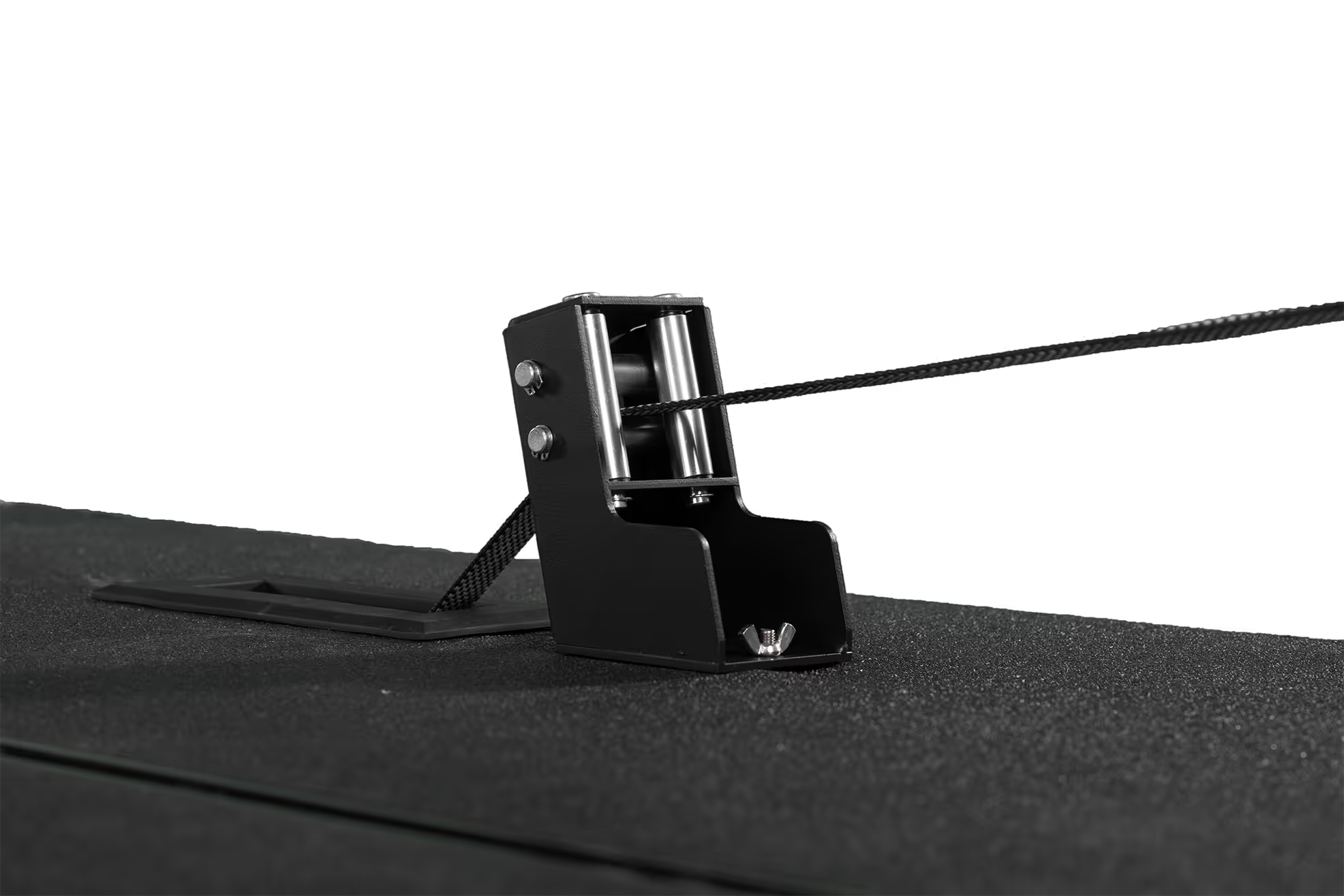




Flywheel training is revolutionizing the way athletes can enhance their athletic and sporting performance. This innovative training modality utilizes the principles of rotational inertia to provide resistance, making it possible to achieve greater eccentric overload compared to traditional weight training. This eccentric overload can be even further enhanced when utilizing motorized boost technology.
During the competitive season, athletes face the challenge of maintaining peak performance while improving their strength and performance outcomes. Integrating flywheel training with a minimum effective dose approach can provide a practical solution to optimize performance gains without risking overtraining.
What is Minimum Effective Dose?
The minimum effective dose refers to the least amount of exercise stimulus required to achieve a desired training adaptation [1,2]. For traditional resistance training in sport, minimum effective dose is essential for balancing the need for progress with the need to avoid overtraining and injury, as well as maintaining strength and power qualities in-season. The concept is particularly valuable in sports where athletes must perform consistently at high levels without accumulating excessive fatigue. Additionally, the benefit of minimum effective dose in sport is the efficient use of time, allowing athletes to place more emphasis on skill development or recovery during the season. Androulakis-Korakakis et al [1], suggested traditional resistance training dose prescriptions should consider number of sets, repetitions per set, load used, and the intensity of effort.
Considerations for Minimum Effective Dose with Flywheel Training
Keijzer et al. [4], discussed how performance increases of jumping, sprinting and change of direction were achieved with 1-3 weekly flywheel training sessions over 6-10 weeks involving 3-6 sets of 6-10 reps [3]. Additionally, flywheel training provides variable resistance which automatically adjusts to the athlete’s effort and ability, making it suitable as an in-season training modality. When managing prescriptions in flywheel training coaches should specifically consider: intensity(inertia), velocity, and the braking styles prescribed [4].
A recent study by Asencio et al. [5] explored the impact of two different flywheel resistance training programs: variable intensity (VI) and constant intensity (CI) [5]. The authors examined the performance characteristics of each program which occurred in the pre-season, attempting to shed light on the concept of minimum effective dose in the team setting.
The Study: Overview
The study conducted by Asencio and colleagues aimed to compare the effects of VI and CI flywheel training programs on specific performance metrics in amateur soccer players who had at least 2 years of resistance training experience. Seventeen participants were divided into two groups: one following a VI protocol and the other a CI protocol. The VI group adjusted the inertial load every four sessions, while the constant intensity group maintained the same load throughout the program.
Both groups underwent ten sessions of flywheel training over five weeks, with assessments conducted before and after the training period, which included sprint speed, change of direction, jump height, one-repetition maximum (1RM), and flywheel strength variables.
The Study: Training Program Prescribed
The training program for both groups involved two flywheel training exercises per session: vertical squat and horizontal lunge. Each group trained twice per week with the following structure:
The total repetitions for each group during the 5-week training period were CI (292) and VI (288). The VI group decreased intensity (inertia) as repetitions increased. In addition to the flywheel training exercises, each group also performed a general warmup, core stability, balance work and a hamstring eccentric exercise.
The Study: Key Findings and Practical Takeaways
Findings
Strength: Both VI and CI groups showed significant improvements in their 1RM values, indicating that flywheel resistance training effectively enhanced maximal strength in lower limbs.
Sprint Performance: Greater improvements (4.02%; p<0.05) in the 10-m sprint in the CI group.
Eccentric and Concentric Power: Both groups exhibited increases in peak concentric and eccentric power, with slightly higher gains of 10.50% and 15.60% respectively observed in the CI group. This emphasizes the importance of utilizing both medium to lower inertial loads for maximizing power output during flywheel training.
Takeaways
The concept of the minimum effective dose is highlighted in this study, particularly in the context of flywheel training. For these athletes, achieving significant performance gains does not necessarily require high training volumes. Additionally, the CI group improved sprint performance suggesting intensity may be a more important consideration when prescribing flywheel training. Training less on the day and progressively increasing the exposure to intensity may lead to better sprint performance outcomes.
Practical Applications for Coaches and Practitioners
Integrating flywheel training with a minimum effective dose approach offers a strategic and efficient way to enhance in-season performance. By focusing on the essential exercises and maintaining a balance between training stimulus and recovery, athletes can achieve significant strength and performance gains while minimizing the risk of overtraining and injury. This approach not only optimizes in-season performance but also supports long-term athletic development [1,2]. As shown in the study by Ascencio, flywheel training can be complemented with other training modalities to enhance performance qualities, understanding if you train a particular quality, it will improve [5]. Still be mindful of the overall training and match schedule as flywheel training sessions should be strategically placed to avoid conflicts with match days and ensure players are not overly fatigued. Lastly, flywheel training programs should be individualized based on players’ specific needs and performance goals.
References
- Androulakis-Korakakis P., Fisher J. P., & Steele J. (2019). The Minimum Effective Training Dose Required to Increase 1RM Strength in Resistance-Trained Men: A Systematic Review and Meta-Analysis. Sports Medicine. 50(4), 751–765.doi:10.1007/s40279-019-01236-0
- Androulakis-Korakakis P., Michalopoulos N., Fisher J.P., Keogh J., Loenneke J.P., Helms E., Wolf M., Nuckols G., & Steele J. (2021) The Minimum Effective Training Dose Required for 1RM Strength in Powerlifters. Front Sports Act Living. 3:713655. doi: 10.3389/fspor.2021.713655.
- de Keijzer K.L., Raya-González J., López Samanés Á., Moreno Perez V., Beato M. (2023) Perception and use of flywheel resistance training amongst therapists in sport. Front Sports Act Living. 5:1141431. doi: 10.3389/fspor.2023.1141431.
- de Keijzer K.L., McErlain-Naylor S.A., Beato M. (2022). The Effect of Flywheel Inertia on Peak Power and Its Inter-session Reliability During Two Unilateral Hamstring Exercises: Leg Curl and Hip Extension. Front Sports Act Living. 4:898649. doi: 10.3389/fspor.2022.898649.
- Asencio P., Moreno F. J., Hernández-Davó J. L., & Sabido R. (2024). Effects of variable intensity and constant intensity flywheel resistance training programs on specific soccer players’ performance. Frontiers in Physiology. 15:1375438. doi: 10.3389/fphys.2024.1375438



Lorem ipsum dolor sit amet, consectetur adipiscing elit. Suspendisse varius enim in eros elementum tristique. Duis cursus, mi quis viverra ornare, eros dolor interdum nulla, ut commodo diam libero vitae erat. Aenean faucibus nibh et justo cursus id rutrum lorem imperdiet. Nunc ut sem vitae risus tristique posuere.