





Why Limb Asymmetry Matters for Athletes
Assessing differences in limbs is common practice among practitioners, as a large difference between limb outputs has been shown to potentially decrease performance and increase the likelihood of injury (2). It also plays an important role in the return to sport process as practitioners often utilize an 85-90% limb symmetry index before clearing an athlete for participation (4).
Limb asymmetry can be quantified by various methods including isokinetic assessments, traditional 1RM strength, jump metrics quantified via force plates, and field-based assessments (i.e., change of direction (COD)).
One understudied area of flywheel training is its ability to quantify and test limb asymmetry (7). However, recently researchers and practitioners have brought light to flywheel limb asymmetry tests.
The Unique Benefits of Flywheel Training
Flywheel training has been gaining popularity in the performance and rehab field over the last decade due to its ability to create large forces and high velocities in both the concentric and eccentric phases. The unique stimulus that flywheel training offers has been shown to translate to increases in jump performance, strength, speed, and COD tasks (1).
In addition, it has been shown to be a safe and extremely beneficial tool in the return to sport process - take a look at the results from an Exerfly case study with Stony Brook University. For instance, Stojanovic et al., reported that flywheel training in late-stage ACL rehab resulted in better return to sport measures in comparison to traditional training among professional athletes (8).
Furthermore, flywheel training has been shown to reduce asymmetries and restore normal joint contribution during an ACL rehab process (3). Given flywheel training’s versatility in day-to-day training and its potentially large impact in the rehab process, having sound flywheel assessments and monitoring tools is crucial to gauge an athlete’s progress.
What the Research Shows
Although the existing literature is small, it does appear that flywheel asymmetry assessments are linked to fluctuations in performance. For instance, 4 studies reported an association between increased asymmetry in concentric power during dynamic flywheel movements (i.e., cross overstep and side step) and worsened COD performance (R2 = .44 - .81) (7). Suggesting that a large deficit in flywheel concentric asymmetry outputs could potentially decrease on field performance.
There is some evidence suggesting that eccentric asymmetry outputs can also be utilized, in which one investigation found that an increase in asymmetry of eccentric power during a flywheel cross step was associated with a decrease in performance of the flywheel leg extension (6). Yet, other studies reported little to no association between eccentric asymmetry outputs and performance outcomes (7). This likely stems from the dynamic assessments utilized (i.e., cross overstep and sidestep), lack of injured athletes analyzed, and the general nature of flywheels as the eccentric outputs are proportional to the concentric outputs.
Practical Applications: From Rehab to Performance
Monitoring asymmetries can be highly valuable, particularly during the return to play process. For example, tracking an athlete’s velocity or force outputs during single-leg movements across sessions can provide meaningful insights into the rehab progress. These monitored movements can include pre-prescribed exercises that are already part of the return to sport program (e.g., split squat, Bulgarian split squat, leg extension). This approach is often referred to as invisible monitoring.
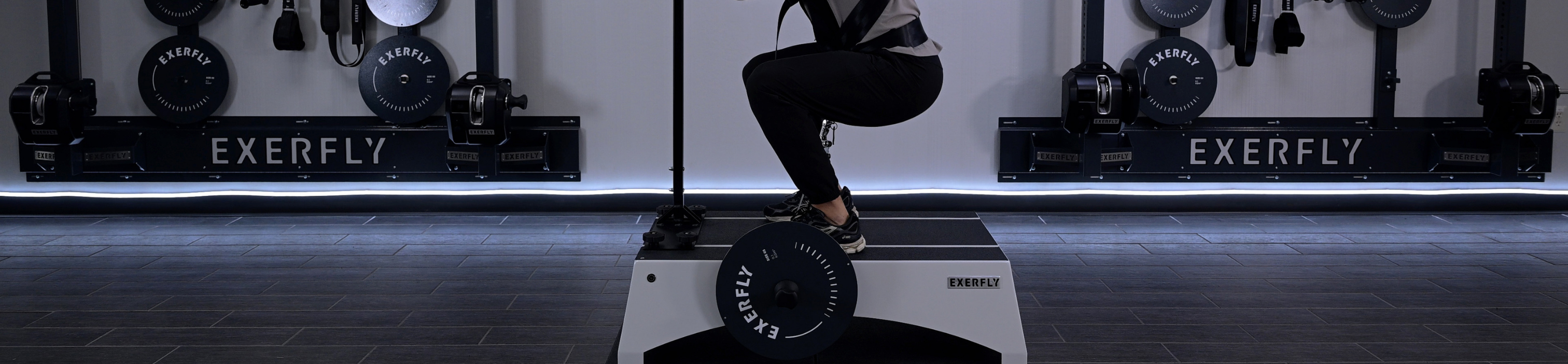
Example of post op ACL athletes rehabbing with the Exerfly Ultimate
In the early stages of rehab, the output of the injured limb will typically be lower than that of the healthy limb when using the same inertial load. As recovery advances, the limb symmetry index should approach approximately 85% (see calculation below) (5).
Limb symmetry index = (injured side/uninjured side) × 100
Performance Setting: When and What to Monitor
In a performance setting, there is generally less emphasis on monitoring asymmetry from session to session. Instead, asymmetry can be analyzed on a monthly or per-phase basis, similar to other performance metrics such as a 1 RM test. The dynamic flywheel cross overstep is the most popular in research and might correspond the best with COD task due to the similar movement patterns.
However, if this exercise is not regularly included in training, its reliability as an assessment tool may be limited. In such, it is advisable to analyze the most frequently performed unilateral exercises in your program (i.e., Bulgarian split squats, leg extensions, leg curls). Although their association with field-based performance tests may differ, they can provide a more consistent and representative measure of limb asymmetry.
How to Conduct the Asymmetry Assessments:
Asymmetry can be assessed in two primary ways:
Method 1: Single Load Assessment (Quick)
- Perform 1–2 sets of 6–8 reps at a single load
- Select a load that reflects the athlete's strength level and training context
- Use a moderate load (inertial load: 0.05–0.1 kg m² or velocity threshold ~ 0.75 m/s)
- Analyze the best 3–5 reps
Method 2: Multi-Load Assessment (Comprehensive)
- Assess asymmetry across multiple loads, ranging from light to heavy (similar to a velocity profile assessment)
- Provides a more comprehensive view of where deficits occur along the force–velocity curve
- Highlights potential side-to-side differences across different intensity zones
Key Takeaways
Flywheel training presents a promising and versatile training tool to improve performance and during the rehabilitation process. As its popularity has advanced, more flywheel testing and monitoring tools such as limb asymmetry test have come to light to help better inform practitioners of training decisions. While the current body of literature is still developing, early research suggests that flywheel asymmetry measures can provide meaningful insights into performance and return to sport progress.
By integrating invisible monitoring strategies and consistent unilateral assessments, practitioners can track progress in performance and ensure athletes meet symmetry thresholds following an injury.
References
1. Buonsenso, A, Centorbi, M, Iuliano, E, et al. A Systematic review of flywheel training effectiveness and application on sport specific performances. Sports 11: 76, 2023.
2. Guan, Y, Bredin, S, Taunton, J, et al. Association between inter-limb asymmetries in lower-limb functional performance and sport injury: a systematic review of prospective cohort studies. JCM 11: 360, 2022.
3. Henderson, FJ, Shimokochi, Y. Inertial one-leg squat training and drop jump biomechanics in athletes with anterior cruciate ligament reconstruction after return to sport. J Strength Cond Res 39: 156–164, 2025.
4. Hewit, JK, Cronin, JB, Hume, PA. Asymmetry in multi-directional jumping tasks. Phys Ther Sport 13: 238–242, 2012.
5. Jordan, MJ, Bishop, C. Testing limb symmetry and asymmetry after anterior cruciate ligament injury: 4 considerations to increase its utility. Strength Cond J 46: 406–414, 2024.
6. Madruga-Parera, M, Bishop, C, Beato, M, et al. Relationship between interlimb asymmetries and speed and change of direction speed in youth handball players. Strength Cond Res 35: 3482–3490, 2021.
7. Mak, MCW, Bishop, C, Beato, M. Validity and reliability of flywheel resistance technology as an assessment method and its association with sports performance and asymmetry: a systematic review. J Strength Cond Res 39: e930–e948, 2025.
8. Stojanović, MDM, Andrić, N, Mikić, M, et al. Effects of eccentric-oriented strength training on return to sport criteria in late-stage anterior cruciate ligament (ACL)-reconstructed professional team sport players. Medicina 59: 1111, 2023.
.png)



Lorem ipsum dolor sit amet, consectetur adipiscing elit. Suspendisse varius enim in eros elementum tristique. Duis cursus, mi quis viverra ornare, eros dolor interdum nulla, ut commodo diam libero vitae erat. Aenean faucibus nibh et justo cursus id rutrum lorem imperdiet. Nunc ut sem vitae risus tristique posuere.