





Flywheel training has earned its place as a go-to tool for athletes, coaches, and rehabilitation specialists who need results faster. Unlike traditional weights that rely on gravity, flywheel devices use rotational inertia to create smooth, user-defined resistance that matches your effort throughout every phase of movement.
Selecting the right flywheel training device depends on your goals, available space, the population you’re working with, and the quality of the equipment itself. Not all flywheel devices are built the same. Differences in build quality, loading capabilities, and whether the system is motorized or non-motorized can dramatically affect performance, durability, and long-term value.
This guide walks you through the key differences between flywheel training device types, explains what specs matter most, and outlines how to match equipment to specific sports and rehabilitation scenarios.
What Is a Flywheel Training Device and How Does It Work?
A flywheel training device creates resistance through a spinning plate rather than stacked weights. Depicted below is a flywheel squat. When the athlete pulls against the rope, the plate starts to accelerate. Once they reach the end range of motion, the plate stored energy pulls back with a similar force that was applied in the pulling phase.
This mechanism means the resistance automatically scales with your force output. Push harder during the concentric phase, and you'll face more resistance during the eccentric phase. This is fundamentally different from barbells, dumbbells, or cable machines where the load stays constant regardless of how much force you generate.
The term "isoinertial" describes this resistance type; the inertia remains constant while the force you experience varies based on your acceleration. Research has found that flywheel training produces significant improvements in athletic performance markers like jump height, sprint speed, and change-of-direction ability (1).
Types of Flywheel Training Devices You Should Know About
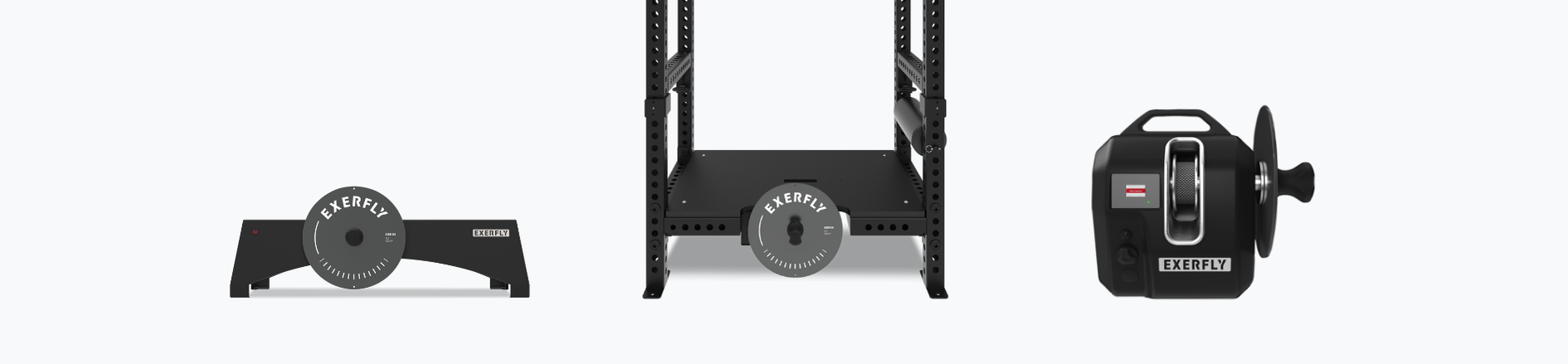
Flywheel equipment generally falls into two main categories: platform systems, which are typically used for lower-body training in a more vertical movement plane, and rack-mounted pulley systems, which offer a wider range of horizontal and rotational exercises.
So how do you decide which one is right for you? Let’s break it down.
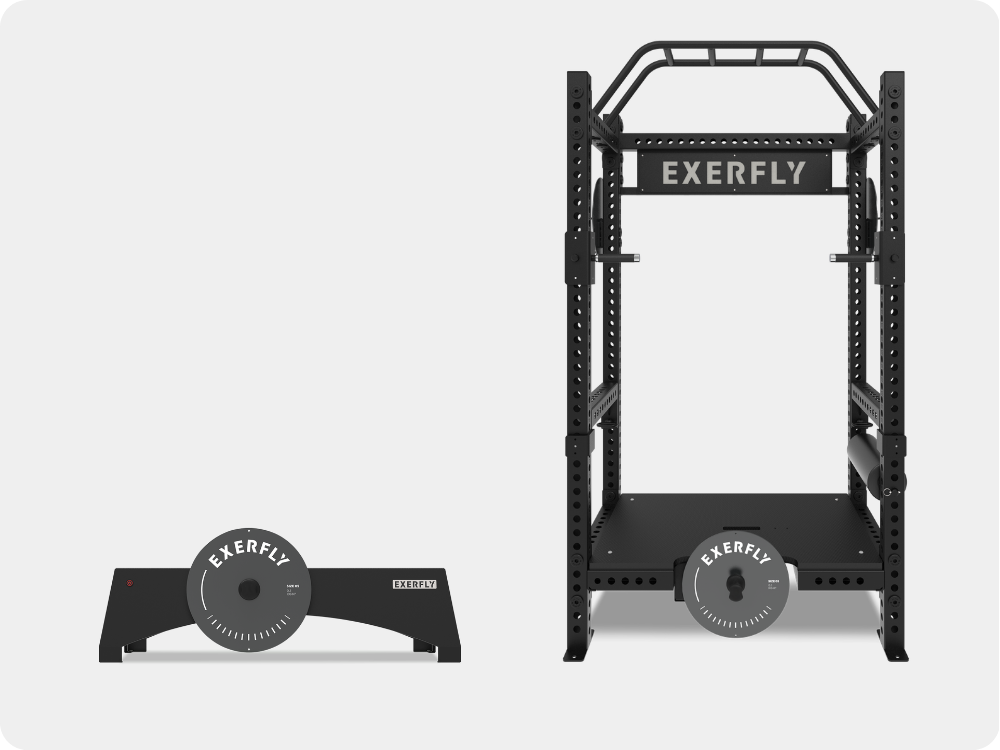
Platform Flywheel Systems
Platform systems feature a flywheel mounted on or beneath a stable standing surface. The user connects the rope to an accessory such as a squat belt, squat vest, or handle, and performs movements such as squats, deadlifts, and lunges against inertial resistance. While these systems are used most often for vertical lower-body loading, accessories can also expand exercise options into horizontal and rotational patterns.
Rack-Mounted Pulley Flywheel Systems
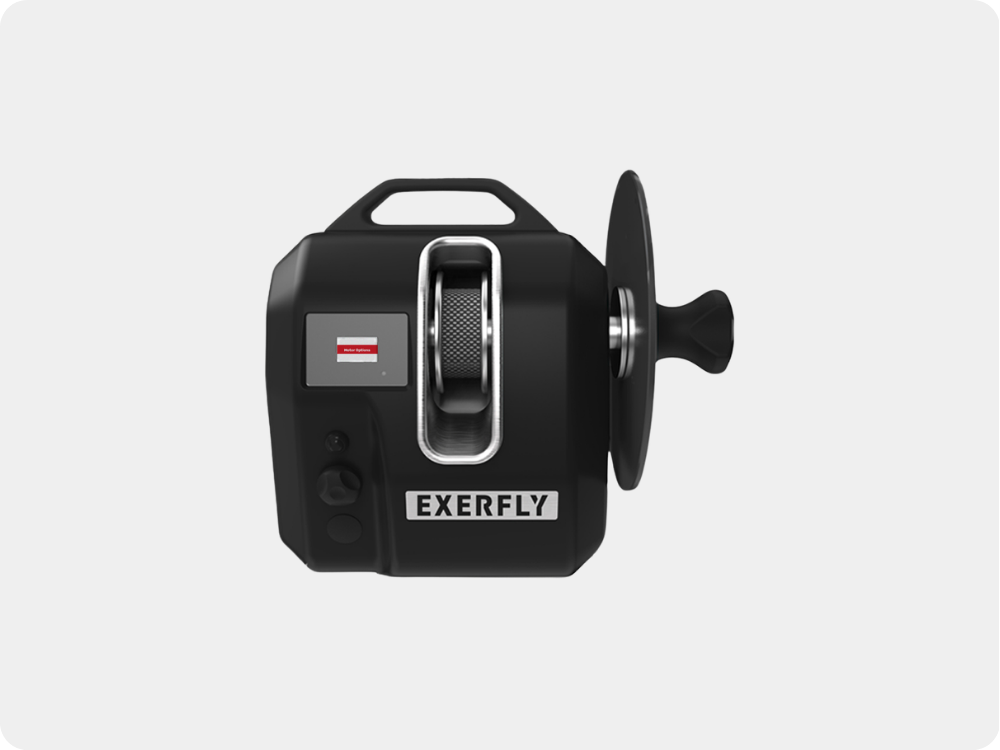
Rack-mounted flywheel devices mount to racks, walls, or portable bases and support pulling, pushing, and rotational movements at different heights and angles. These systems are generally better suited to upper-body work using horizontal and rotational planes.
In practice, any exercise you can do with a cable pulley machine can also be performed with these flywheel systems: rows, presses, rotations, and more, just with inertia-based, eccentric-focused resistance instead of the gravity-based, weight-stack resistance of traditional cable machines.
What Specs Matter Most When Choosing a Flywheel Device?
Not all flywheel devices perform equally. Understanding the specifications that impact training quality and equipment longevity will help you invest in equipment that supports long-term athlete development.
Inertia Range and Flywheel Options
Inertia determines how the device responds to force application. Lower inertia flywheels accelerate quickly, creating faster eccentric–concentric transitions suited for power and velocity training. Higher inertia values require more force to get moving and to slow down, making them better for heavy strength and eccentric loading.
It’s important to choose a device that offers multiple flywheel sizes and the ability to stack flywheels. This flexibility lets you program for different training goals, from high-velocity speed work to heavy eccentric loading.
Exerfly flywheel devices have the highest inertial range on the market: 0.00625 kg·m² – 0.8 kg·m², with the ability to stack up to 8 large flywheels at once. This gives you more options to fine-tune resistance across the full spectrum of strength, power, and speed work, as well as rehab and return-to-play progressions.

Dual-Pulley vs. Single-Pulley Performance
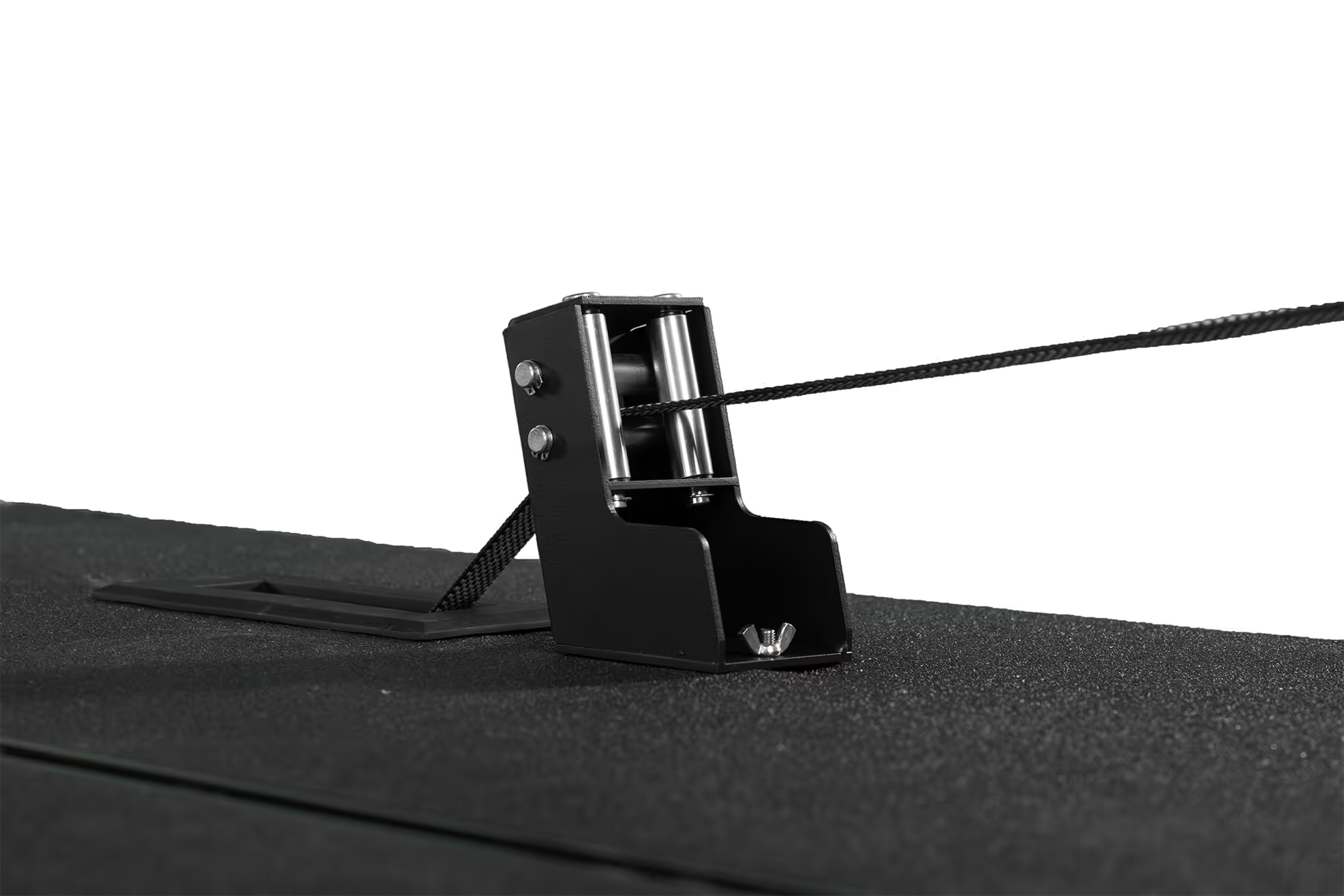
Dual-pulley systems have more friction, which makes them slower and less responsive than single-pulley systems. Although they may produce higher force output at the same inertia, they do not offer the same speed capabilities or fast concentric-to-eccentric transitions.
Single-pulley systems are generally faster and better suited to speed and power training. Their quicker transitions can also support better stretch-shortening cycle utilization.
Motorized vs. Non-Motorized Flywheel Training
Standard flywheel devices offer a 1:1 resistance ratio (concentric:eccentric), meaning they can only return as much energy as you give during the concentric phase. While flywheel training is an excellent tool for emphasizing eccentric loading, standard flywheels do not inherently create true eccentric overload.
Achieving true eccentric overload with flywheel training requires either external assistance or Exerfly Motorized Technology.
Exerfly’s Motorized Technology lets you add up to 80% additional resistance in the eccentric phase, based on your concentric output. Eccentric overload can be progressed in as little as 1% increments via the Exerfly App. This precision matters for rehabilitation protocols, where specific dosing drives outcomes, and for performance training, where progressive overload requires accurate load management.
Feedback Systems and Data Tracking
Modern flywheel training benefits from real-time feedback across a range of performance metrics. For example, the built-in Exerfly sensor provides live metrics on the Exerfly app, including:
- Mean Velocity (m/s)
- Peak Velocity (m/s)
- Mean Power (W)
- Mean Acceleration (m/s²)
- Mean Torque (N·m)
- Mean Force (N)
This data motivates athletes, guides progressive overload decisions, and helps practitioners document improvement over time.
Some flywheel devices include built-in sensors that measure torque, velocity, and power directly, sending data to an app or dashboard without extra hardware. Others rely on add-on measurement tools, such as external sensors or third-party encoders that attach to the rope, shaft, or frame. A few systems still offer no sensor option at all, providing only basic mechanical resistance with no built-in way to quantify output.
When choosing a device, consider which metrics matter most for your use case and whether the measurement system has been validated against laboratory-grade equipment. Many devices claim to measure certain metrics but have never been validated. Not all devices that claim to measure certain metrics have been independently validated.
You can view a validation of the Exerfly App here.
Portability and Space Requirements
Think about where you’ll use the equipment: Will it stay in one spot, move between training rooms, travel to competitions, or need to be stored compactly when not in use?
Platform systems range from heavy, permanent installations to lightweight portable units. Rack-mounted pulley devices vary from fixed wall-mounted options to stand-alone portable setups.
Like anything, there are trade-offs. While a device may be lightweight and easy to move, it often lacks the mass needed to stay firmly grounded under high-force loads. In platform systems especially, insufficient weight can cause the unit to shift, wobble, or even jump during powerful squats, deadlifts, or unilateral movements. Heavier, more stable platforms handle higher forces more safely, but they’re harder to relocate and store.

A Decision Framework for Selecting Your Flywheel Training Device
Use this step-by-step process to narrow your options and make a confident selection.
Step 1: Define Your Primary Use Case
Start by identifying the training scenarios you'll encounter most frequently. Are you primarily training lower-body strength for team sport athletes? Running rehabilitation protocols for post-surgical patients? Developing rotational power for golf or baseball players?
Your primary use case determines whether you need a platform or rack-mounted pulley system.
Step 2: Assess Your Space and Portability Needs
Measure your available training space and consider traffic patterns. Will the device stay in one location? Need to move between rooms? Travel to client sites? Store when not in use?
Weight, dimensions, and storage options vary dramatically across flywheel equipment.

Step 3: Evaluate Your Budget Against Required Features
Flywheel devices range from basic manual systems to motorized devices with integrated feedback. Motorized eccentric overload and quality data tracking cost more but deliver capabilities you can't replicate otherwise.
Training area is another feature to weigh: a larger training surface gives athletes room for proper foot placement, accommodates a wider range of athlete sizes, and enables more exercise options, while smaller training surfaces limit exercise capability and versatility.
Consider the return on investment: How much time and results improvement justifies the additional cost? A single flywheel device can often replace multiple pieces of equipment — such as a leg press, squat rack, belt squat, and cable machine — which adds further value when weighing up the investment. For professional sports and clinical settings, systems with motorized eccentric overload often pay for themselves through better outcomes.
Step 4: Prioritize Build Quality and Long-Term Durability
Equipment is only valuable if it stands the test of time, and heavy use. Cheaply built flywheel devices can have a short shelf life and quickly end up collecting dust in the corner of the gym. Look for devices built with robust materials and solid engineering that can withstand daily, high-force training from multiple athletes.
Every Exerfly device is proudly made in the USA and backed by more than 30 years of manufacturing excellence from Dynamic Fabrication and Finishing, right here in Wisconsin. Each product is designed with durability at the forefront to endure the demands of high-use environments.
Step 5: Post Purchase Support and Education
As flywheel training continues to grow as a training method, having access to strong post-purchase support is a major bonus for implementation and programming. Exerfly offers frequent one-on-one support check-ins with our team of in-house sport scientists so you can use the equipment correctly and confidently from day one.
Step 6: Consider Future Growth
Will your needs change in the next 2–5 years? A growing clinic might start with one device and add more later. A performance facility might want to expand exercise variety through accessories and different movement patterns.
Choose systems that allow expansion without starting over. Standardized mounting options, a clear accessory ecosystem, and modular designs protect your initial investment and make it easier to grow your flywheel training program as your facility and athletes evolve.
Exerfly systems are among the most versatile options on the market when it comes to the ecosystem of accessories. These accessories open up a range of exercises that were previously not possible with one flywheel training device, allowing you to train across multiple movement planes, from vertical lower-body loading to horizontal and rotational patterns, without needing multiple separate systems.
In Conclusion
Selecting a flywheel training device comes down to matching equipment capabilities to your specific training goals, space constraints, and budget.
The most important specs to evaluate are inertial range, single or dual-pulley design, build quality, motorized eccentric overload capabilities, feedback system quality, and training platform size. Don't overlook portability requirements or post-purchase support when making your decision.
If you have questions about which flywheel device is the right fit for your setup, feel free to get in touch, we're happy to help.
References



Lorem ipsum dolor sit amet, consectetur adipiscing elit. Suspendisse varius enim in eros elementum tristique. Duis cursus, mi quis viverra ornare, eros dolor interdum nulla, ut commodo diam libero vitae erat. Aenean faucibus nibh et justo cursus id rutrum lorem imperdiet. Nunc ut sem vitae risus tristique posuere.