







Introduction
I was introduced to flywheel training a few years ago as the women's basketball strength and conditioning coach at the University of Virginia, and I quickly saw the wide range of applications for this training tool.
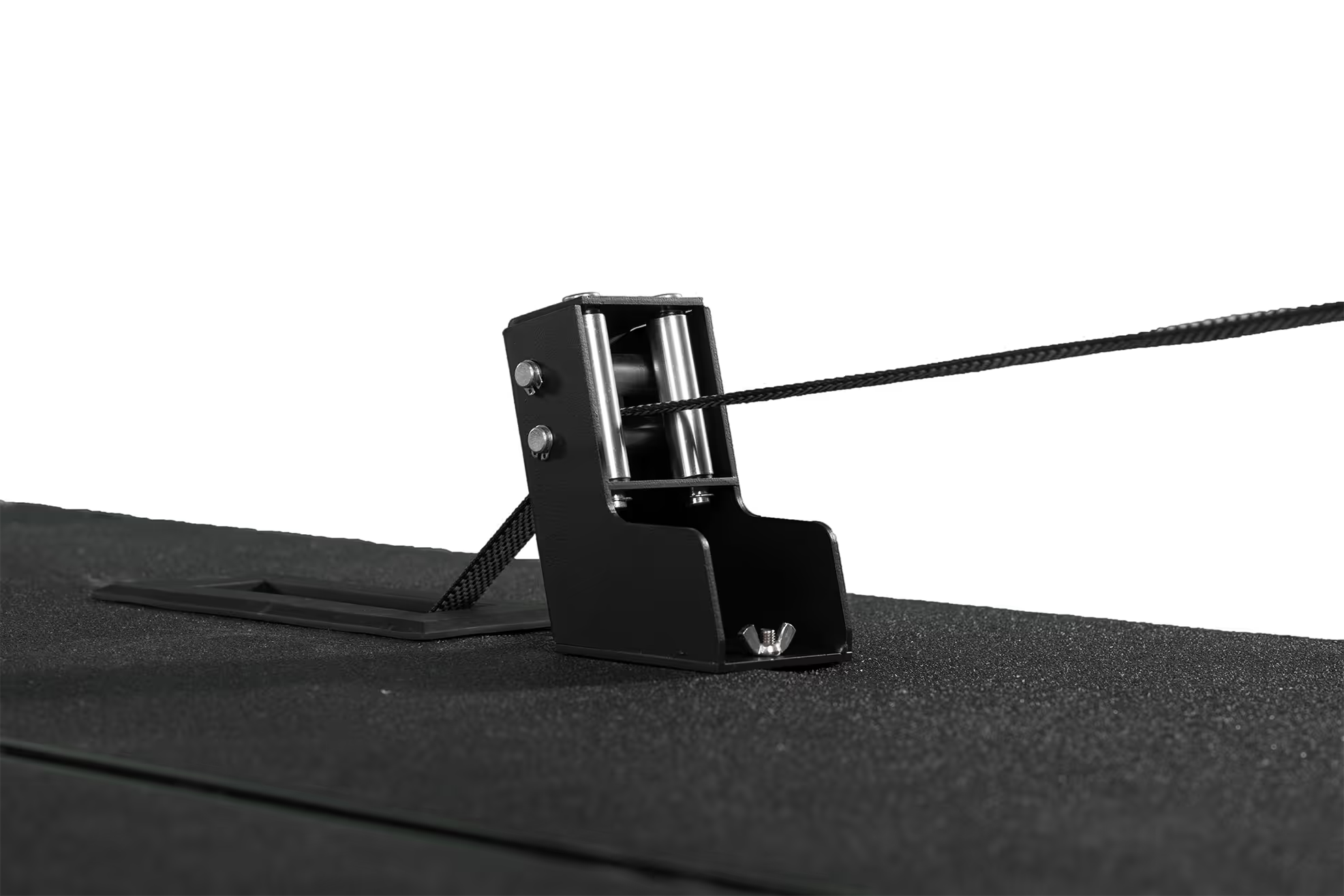
As a sport exercise scientist working with athletes returning to play after injury or looking to enhance performance, I have found flywheel training to be a tremendous asset. It is a tool I can use across the entire training and rehabilitation spectrum. The versatility of the Exerfly RackFly and Ultimate gives practitioners the ability to work in all planes of motion and elicit training responses to the force vectors specific to an athlete's sport. The only limit is the practitioner's creativity in designing exercises and programs that fit the needs of the athlete.
How I Use Flywheel Training for Rehabilitation
Applications across injury types
From a rehabilitation perspective, I have used flywheel training to help athletes return to play after a range of injuries, including ACL reconstruction, meniscus injuries, ankle sprains, Achilles rupture repair, shoulder labral injuries, shoulder impingement, and hamstring and groin strains. In each case, flywheel training was part of the athlete's rehabilitation protocol to help them reach and exceed their pre-injury performance outputs.
Addressing strength asymmetries and enhancing force application
Flywheel training can be incorporated from isolation to compound movements, and from single-plane to multiplanar patterns. The Exerfly software and motorized eccentric overload technology can be used to reduce limb strength asymmetries by targeting deficits in the muscle contraction phase of focus. Moreover, because the flywheel uses accommodating resistance based on kinetic energy rather than gravity, it improves load and force application across the length-tension relationship, allowing athletes to develop force more effectively through both the ascending and descending slopes of the muscle contraction.
Progressing through the rehabilitation continuum
Flywheel training can be applied throughout the rehabilitation periodization process, from early stages focused on hypertrophy and strength endurance through mid- and late-stage rehabilitation, where the emphasis shifts to maximal and explosive strength. The wide range of applications this modality offers across the rehabilitation continuum makes it an extremely valuable tool for any practitioner.
Using the Exerfly Motorized Technology to overload the eccentric phase and accentuate braking has helped create a better force profile for generating higher-quality propulsive force outputs in vertical, linear and lateral movement patterns. Improving force production, rate of force development, velocity, and movement quality during the eccentric (braking) phase can enhance the subsequent amortization and propulsive phases of movement throughout the rehabilitation process.
Holistic approach and efficient programming
Treating the patient or client holistically is a core principle of my rehabilitation methodology. Injury can produce kinetic and/or kinematic pathology in other regions of the body from compensation in movement patterns. Flywheel training has allowed me to incorporate complex movement patterns in a controlled environment, improving strength and movement efficiency, and, ultimately, client outcomes. Moreover, many insurance plans do not provide enough treatment sessions to complete a full rehabilitation process. Therefore, creating efficient programming that shortens the return-to-play timeline while delivering optimal outcomes is imperative.
How I Use Flywheel Training for Athletic Performance
Strength for sport-specific movement
When it comes to optimizing athletic performance, this tool can be applied to any sport or athlete. In almost two decades of training experience, I have worked with athletes in football, basketball, baseball, soccer, sailing, track and field, bobsled and more, each requiring different strength and power characteristics across various planes and movement patterns. The flywheel has been a great asset to my programming, from general physical preparedness strength phases to competitive training blocks built around more sport-specific explosive strength. As an athlete progresses through speed and change-of-direction work and the degrees of freedom increase, the flywheel allows the practitioner to develop strength characteristics for those more complex patterns of motion.
Constant tension through the full range of motion
It is especially useful for exercises where gravity and body position affect the load and activation of certain muscle groups, and where I want more load and even tension through specific ranges of motion. Adding the flywheel to exercises such as back extensions and reverse hypers has increased load through the entire range of motion, improving both the feel and the effect of the exercise.
Loading beyond the vertical vector
Free weights emphasize vertical force components. For more sport-specific movements that call for anterior-posterior or medial-lateral loading, such as split squats with anterior tibial translation or lateral squats for change-of-direction training, the flywheel provides load and force application in those specific vectors.
Flywheel Training for Priming and Potentiation
Beyond rehabilitation and performance programming, I love using the flywheel for prime, preparation and potentiation exercises in warm-ups before speed and change-of-direction sessions. It is a great way to prime athletes for the movement patterns that will be the focus of the session, whether that is maximum velocity, linear acceleration and deceleration, lateral change of direction, pivoting, cutting or hip switches.
Isolated preparatory movements on the flywheel help athletes build kinesthetic awareness of the body positions and angles they need to achieve better outcomes, while feeling tension in the desired musculature. The RackFly applies a constraint which is beneficial for breaking a movement pattern down in isolation before performing the speed drill. The constraint manipulates the athlete's movement by guiding them to a certain movement pattern, so I don't have to use many verbal cues to improve form, allowing the exercise set-up to enhance skill acquisition. This allows athletes to refine technique before the session starts.
Software, Feedback and Autoregulation
The Exerfly app is extremely valuable, not only for examining force and velocity but also for autoregulation: determining loads for the session and driving intent. Instantaneous feedback on every rep has helped with both motivation and performance outputs. When programming for a certain 1RM percentage or percentage range to enhance speed or power, asking athletes to move fast and explosively can be a tough proposition to ask of an athlete because their effort and speed is subjective.
Utilizing objective quantitative metrics to program specific strength and speed zones will help drive appropriate stimulus and minimize fatigue. With the software providing force, velocity and acceleration metrics, programming becomes accurate and efficient for the coach and athlete. Now, with the ability to set a target or percentage drop-off, you can program each session precisely for the adaptation you want to generate in your athlete.
Final Thoughts
Few training tools can span the full continuum from rehabilitation to athletic performance. In my experience, flywheel training is one of them. Its versatility allows me to adjust the exercise, loading strategy, movement pattern and training stimulus to meet the athlete where they are, then progress those demands as they move toward full performance.
The Exerfly Motorized Technology becomes particularly valuable in the later stages of rehabilitation, when the goal shifts from restoring basic strength and capacity to preparing the athlete for the high eccentric and braking demands of their sport. The ability to progressively increase eccentric overload provides another way to challenge an athlete's ability to absorb and redirect force, while targeting specific movement patterns and force vectors that are relevant to their return to play.
Rather than treating rehabilitation and performance as separate stages, flywheel training gives me a tool that can evolve with the athlete throughout the process. It gives practitioners another way to bridge the gap between restoring capacity and preparing athletes to meet the demands of their sport.



Lorem ipsum dolor sit amet, consectetur adipiscing elit. Suspendisse varius enim in eros elementum tristique. Duis cursus, mi quis viverra ornare, eros dolor interdum nulla, ut commodo diam libero vitae erat. Aenean faucibus nibh et justo cursus id rutrum lorem imperdiet. Nunc ut sem vitae risus tristique posuere.