


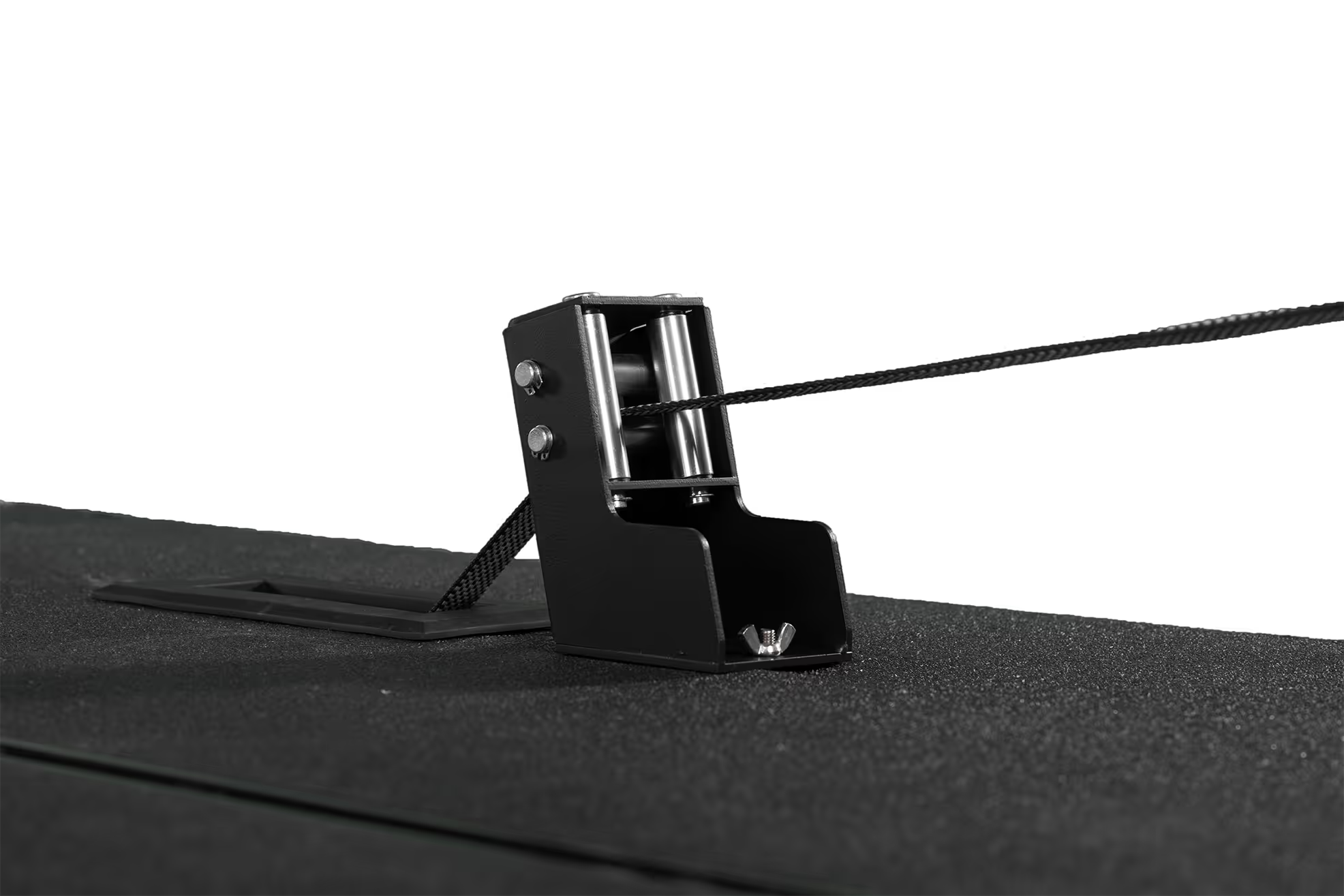




The eccentric loading provided by flywheel training is a primary reason it’s rapidly gaining popularity across performance, clinical, and general fitness settings. The user applies effort and force during the concentric phase of each rep, building kinetic energy that is returned as eccentric resistance on the way back. Specific techniques are then used to target “eccentric overload,” either by condensing the braking demand into a brief period or by assisting the concentric phase to add extra energy to resist against.
While these strategies are effective, they’re limited in terms of how precisely you can prescribe and progress eccentric overload, and in the max eccentric overload you can create without drastically modifying your movement technique. By adding 1-80% extra kinetic energy to the eccentric phase of each rep, the Exerfly Motorized Technology creates a much more versatile, precise, and scalable form of eccentric overload while maintaining the useful characteristics of flywheel training.
How does Exerfly Motorized Flywheel Training Technology work?
During a standard flywheel set, the eccentric work required is dependent on the kinetic energy put into the system during the concentric phase. The Exerfly Motorized Technology adds additional kinetic energy to resist against during each rep, adding eccentric demand in a precise and powerful way.
The kinetic energy is a function of the inertia of the flywheels and the speed they’re spinning. If you increase one or both variables, kinetic energy increases.
Formula for the kinetic energy of a spinning flywheel:
KE = ½ * I * (w2)
KE = Kinetic Energy (J)
I = Inertia (kgm2)
w = angular velocity (rad/s)
A motor combined with a high-performance sensor is an efficient way of adding kinetic energy to spinning flywheels via changes in their rotational velocity.
To bring it all together, here’s how the Exerfly Motorized Technology works:
- The user selects a percentage of “eccentric boost” on the device console or in the Exerfly App. This programs the motor to add the selected percentage of extra kinetic energy to the eccentric phase of each rep.
- The sensor measures the velocity and kinetic energy in real-time.
- While transitioning into the eccentric phase, the motor kicks in and adds the right amount of extra velocity to boost the kinetic energy of the device by the selected percentage.
How does this compare to other eccentric training methods?
Flywheel training already offers a unique training stimulus and experience. The Motorized Technology adds a layer of precision, versatility, and scalability on to an already effective training method.
How is motorized flywheel training different to standard (non-motorized) flywheel training?
With standard flywheel training, the kinetic energy built up concentrically creates the eccentric resistance. To create eccentric overload, specific techniques are used. Two of the most common are:
- Delayed Braking: the user brakes powerfully out of the late eccentric phase. This distributes the eccentric loading to a brief period of intense braking effort.
- Assisted Concentrics: technique is used to add extra energy to the flywheel during the concentric phase to amplify the eccentric demand. This usually involves using more muscle during the concentric phase than the eccentric (e.g., using both limbs to accelerate the flywheels, but only one to decelerate).
These methods are commonly used in both research and practice with good results. But it’s hard to be precise when prescribing or progressing the amount of eccentric overload provided. Additionally, there is only so much eccentric overload you can achieve with these strategies alone, without resorting to extreme techniques.
Motorized flywheel training addresses these limitations in several ways:
- Precise amounts of extra kinetic energy are added to each rep, making it easy to prescribe and progress the eccentric overload over time.
- The eccentric overload can be applied to any movement, without requiring techniques like delayed braking or assisted concentrics (though those strategies are still available during motorized sets).
- Eccentric loading can be progressed nearly indefinitely, as the ability to add up to 80% extra kinetic energy is substantial. This allows you to meet the needs of even the strongest and most powerful trainees.
The result is a method which combines the benefits of flywheel training with the versatility, precision, and eccentric loading capacity of motorized resistance.
How is motorized flywheel training different to eccentric loading with traditional equipment?
Standard strength training with traditional equipment (e.g., barbells, dumbbells, cable stacks, etc.) tends to underload the eccentric phase. Human muscles are not only stronger during eccentric actions, but it also requires less force to lower a weight with gravity than lift it against gravity. For that reason, it’s common to see a noticeable drop in muscle activation during the eccentric phase unless something is done to increase the eccentric intensity (2,6).
One approach is to add extra weight during the eccentric phase relative to what was lifted, using either weight releasers or having spotters add extra weight at the top of the movement. Alternatively, you could lower the same weight but with less muscle mass. For example, perform the concentric phase of a leg extension with two legs, then lower with just one (i.e., the 2-1 method).
These strategies do increase the total eccentric work, but they also have practical challenges. For example, weight releasers are generally tricky to set up with certain exercises and only apply the extra eccentric loading to the first rep of a set. Relying on spotters requires extra people to be available, and for them to be coordinated while adding and removing the weight. And in each of these cases, it’s primarily a slow moving, high external load form of eccentric overload.
Motorized flywheel training is a useful and versatile alternative, which can be applied to any exercise or movement. It provides extra eccentric loading to each rep of a set while also scaling to the user’s input or capacity in real-time. Finally, by adjusting the inertial load, motorized flywheel sets can be used to target high force, strength-oriented eccentric loading as well as rapid, powerful eccentric actions.
Common use-cases for the Exerfly Motorized Flywheel Training Technology
There are many specific use-cases for the Exerfly Motorized Technology. But here are a few of the most common that we see.
Improving Eccentric Strength
Flywheel sets with high inertial loads are commonly used to develop strength-related qualities. By adding the Motorized Boost to the mix, we can increase the eccentric work and force required to decelerate the large spinning flywheels, making it particularly useful for developing eccentric strength and force capacity.
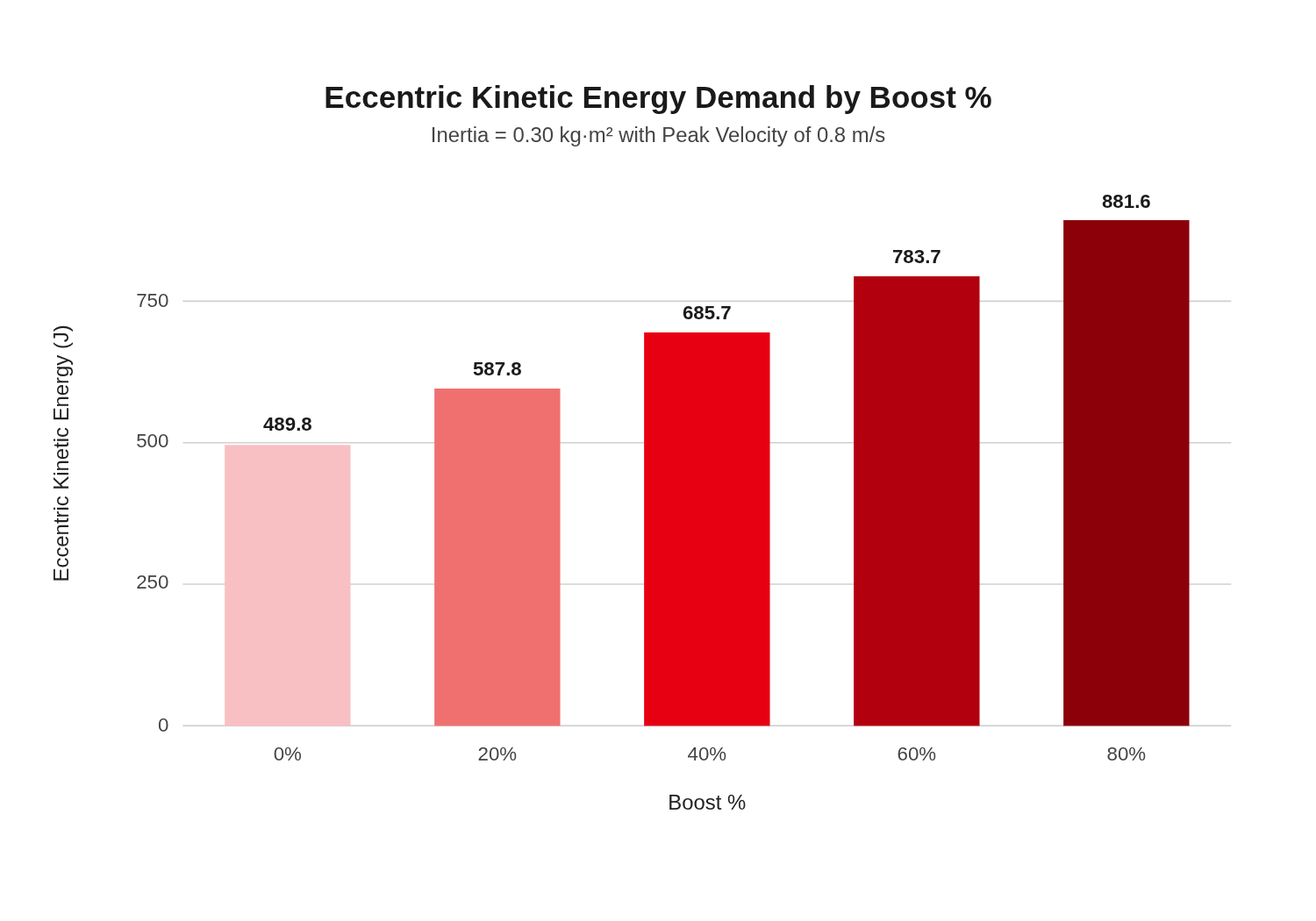
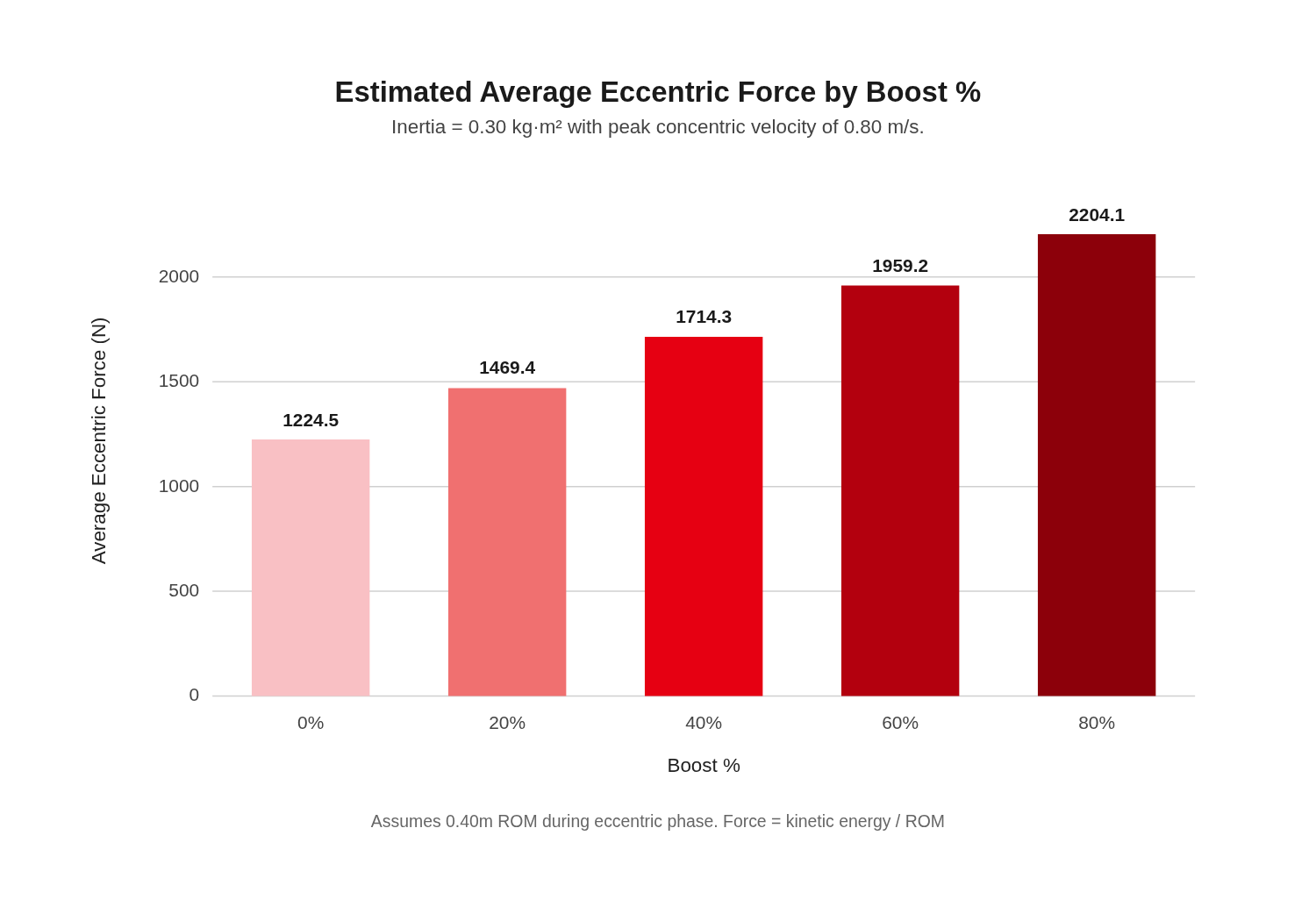
The figures below show an example of a high inertia set (e.g., 0.30 kgm2). In figure 1, you can see the effect of different motorized boost percentages in terms of the eccentric work required during each rep. In figure 2, I’ve calculated the estimated average eccentric force that would be required if range of motion and braking technique are consistent. It shows that if the inputs stay the same, the Motorized Boost can add substantial amounts of eccentric demand to each rep.
Developing powerful eccentric and stretch shortening cycle actions
Flywheel training has emerged as an effective way of developing athletic qualities like changes of direction, vertical jumps, and running economy (1,7). These actions require the athlete to brake and then redirect their momentum in a new direction, leveraging stretch shortening cycles to produce higher power and more mechanically efficient movements (5). Additionally, eccentric actions in sport often occur at fast speeds. For example, athletes must regularly apply rapid eccentric loading through the limbs when decelerating from fast running speeds (3).
Motorized flywheel sets are an ideal way to develop the capacity to perform and tolerate fast eccentric loading and powerful SSC actions that underpin these actions. By adding speed and kinetic energy to resist against, athletes can be exposed to faster and progressively more powerful eccentric actions over time. Notably, the loading is always relative to what the athlete can put into each rep and can be applied across different loads, speeds, and movement patterns (including lateral or rotational patterns), which is not the case for many other eccentric training methods.
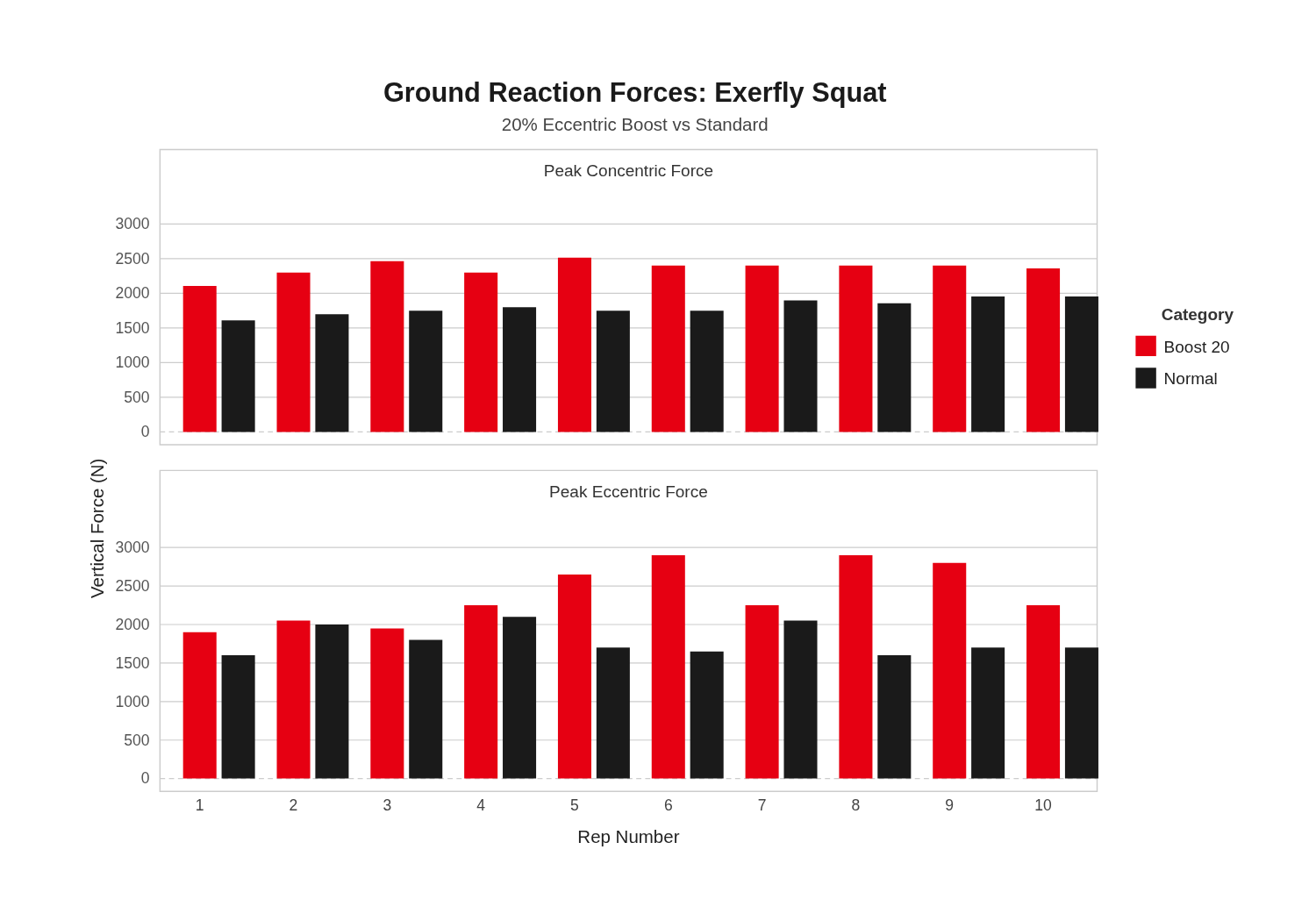
As an example, the figure below shows the concentric and eccentric forces measured by force plates during sets of flywheel squats on the Exerfly Ultimate. Not only did a 20% motorized boost increase the peak eccentric forces during each rep, but this translated to higher peak concentric forces. This is likely because effective use of fast and powerful eccentric actions can often allow for higher concentric outputs as you re-accelerate into the new direction (4).
Exerfly Motorized Flywheel Technology in Rehab and Return to Play
The Exerfly Motorized Technology also plays a key role in injury rehab and return-to-play. After regaining some initial function during early phases of rehab, non-motorized flywheel training can be a useful way of targeting eccentric qualities and tissue adaptations. During later stages, the motorized technology can progressively expose the tissues and movement patterns to higher eccentric loading and speeds, with the eccentric loading still always based on how much the athlete puts into each rep. This serves as an excellent way to safely and efficiently introduce and progress eccentric loading and target key eccentric and connective tissue adaptations. Notably, this eccentric loading always scales to the user’s capacity in real-time, and can be provided without the ground impacts or external load that accompany plyometrics and traditional accentuated eccentric loading methods.
We have seen many rehab practitioners have success implementing the motor with injuries such as ACL rehabilitation. Here are a few case studies to check out:
ACL Rehabilitation Using Exerfly Flywheel Training: A Case Study with Urban Zone
"We can confirm via our data that not only did our athlete gain back his strength which he lost post-operation, he also decreased the asymmetries gained by the nature of the injury to a minimal extent. In addition to that, the strength and power gained in the developed muscle groups are classified within the normative data range and even higher."
Read Case Study Here
Motorized Flywheel Technology to Boost ACL Rehabilitation: A Case Study with Stony Brook University
"The incorporation of motorized flywheel resistance training in a return to sport program following an ACL injury resulted in enhancement in a host of performance assessments. To highlight a few, there was an increase of 14% in CMJ height, 39% in squat, 58% in single leg jump height with the injured limb, 46% in braking force with injured limb, and 35% in single leg jump height symmetry index."
Read Case Study Here
Summary
Exerfly Flywheel Training adds a degree of versatility, precision, and eccentric loading capacity to an already effective training method with the help of the Eccentric Motorized Flywheel Technology. By adding a precise amount of extra kinetic energy to each rep, you maintain the input-dependent and isoinertial nature of flywheel training, but with the ability to generate eccentric overload in a way that can be precisely prescribed and progressed, and with a much higher total eccentric loading capacity than non-motorized flywheel training,
Wanting to learn more about Exerfly Motorized Flywheel Training? Check out this blog on introducing and progressing the method here or leave a comment down below and an Exerfly sport scientist will answer your questions.




Lorem ipsum dolor sit amet, consectetur adipiscing elit. Suspendisse varius enim in eros elementum tristique. Duis cursus, mi quis viverra ornare, eros dolor interdum nulla, ut commodo diam libero vitae erat. Aenean faucibus nibh et justo cursus id rutrum lorem imperdiet. Nunc ut sem vitae risus tristique posuere.