


Title: Efficacy of a multimodal rehabilitation program for enhancing long-term neuromuscular and functional recovery after ACL reconstruction: A randomized controlled trial.
Journal: Journal of Orthopedic Reports
Link to study: https://www.sciencedirect.com/science/article/pii/S2773157X26001153?via%3Dihub
Background of Study
Sports that involve high-intensity jumping, sprinting, and changes of direction can have a high risk of ACL injury and reconstruction, often involving a long recovery period and a relatively high rate of re-injury or persistent issues in the future (1). For this reason, there is considerable interest and incentive for developing and refining effective rehabilitation and return to play protocols which address key neuromuscular deficits, prepare the tissues to tolerate sport-related loading, and build confidence in the athlete to return to their sporting demands.
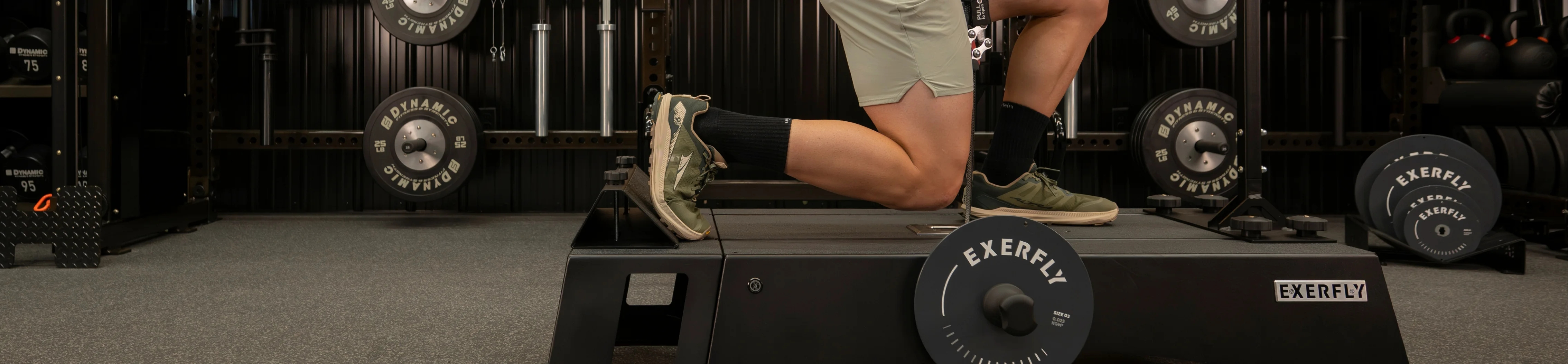
Recent research has highlighted the potential benefits of including flywheel-based eccentric loading within ACL rehabilitation and RTP protocols. For example, a recent study (2) found that an eccentric-focused rehab program with a heavy focus on flywheel exercises had advantageous effects on neuromuscular performance compared to a comparison rehab program.
But most studies focus on short-term outcomes. It is important to evaluate whether flywheel exercises can help contribute to longer term benefits after ACL reconstruction.
Purpose of Study
The purpose of this study was to evaluate the long-term effects of 6-week ACL rehab programs with and without added flywheel training exercises. The authors hypothesized that the added flywheel loading would result in more stable benefits across the 12-month follow-up period compared to the conventional rehab program.
Methods
Participants
After screening for eligibility,112 participants were assigned to one of two groups (56 in each group):
- Conventional Rehab
- Conventional Rehab + Flywheel Exercises
Across the study period, 11 participants from each group dropped out or did not complete the study, resulting in the analysis of 45 participants from each group.
All participants were between 18 and 45 years of age and had ACL reconstruction from the same Orthopedic surgeon at least 3 weeks prior to enrolling in the study.
Rehab Protocols
Both groups completed 6-weeks of standard ACL rehab, which used a phase-based approach, focused on restoring range of motion, strengthening the quadriceps and hamstrings, managing pain and symptoms, and retraining and exposing the tissues to key movement patterns. The flywheel group also performed two flywheel sessions per week, consisting of 3 sets of 10 reps for the half-squat, lateral squat, and lunge exercises. The inertial load was gradually progressed over time based on a target rating of perceived exertion of 7-8, their movement technique and quality at each load, and if the training well tolerated in terms of joint stiffness, pain, and effusion.
Measurements
Measurements were taken before training, 6-weeks after training, 6 months after training, and 12 months after training.
At each timepoint, the following measurements were taken:
- Concentric and eccentric power on the flywheel device.
- Max isometric force during an isometric half-squat.
- Muscle endurance, measured as the time the participant could complete repeated reps until fatigue on the flywheel device.
- Balance, quantified as the percentage of deviation from the neutral vertical position during a 10-second half-squat hold (e.g., less deviation indicated better stability during the balance task).
- Validated patient questionnaires, including the Cincinnati Knee Rating Scale (CKRS), Oxford Knee Score (OKS), and the Knee Injury and Osteoarthritis Outcome Score (KOOS).
Key Results
The key changes from baseline (before training) to after 12-months post-training are shown in the table below. The group that added flywheel training to the conventional rehab program experienced larger average within-group improvements for all major measures compared to conventional rehab only.
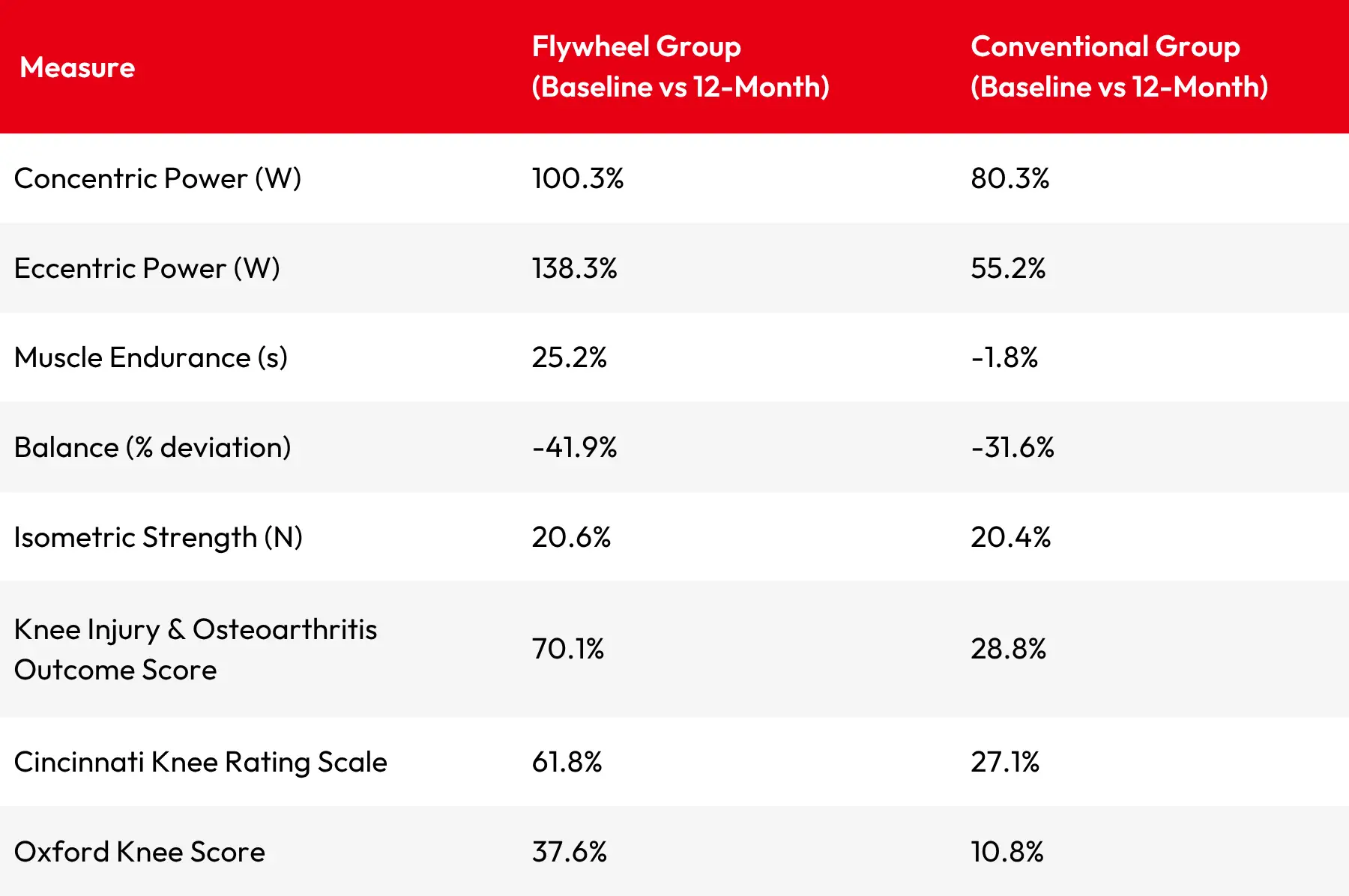
When comparing the two groups at the 12-month follow-up time, the flywheel group had statistically greater changes in concentric power, eccentric power, muscle endurance, balance, and all three functional patient-reported questionnaire scores. Isometric strength improved similarly in both groups.
Discussion and Key Takeaways
Overall, adding flywheel training exercises resulted in better long-term results across multiple neuromuscular and functional measures compared to the conventional rehab protocol alone.
The authors suggested this benefit could be due to the isoinertial resistance and eccentric overload offered by flywheel training. This would theoretically provide benefits like high tension and muscle activation across the range of motion, greater muscle function and size, exposure to coordination demands, and tendon stiffness or other connective tissue adaptations.
Importantly, the benefits persisted well beyond the 6-week training period, with the flywheel group showing significant benefits over the conventional rehab group up to 12-months later. The authors concluded that adding flywheel-based loading could be useful during ACL rehab and may be particularly useful for preparing injured athletes for the eccentric demands of sporting actions like changes of direction and jumping.
References
- Belozo, F. L., Belozo, R. S., Lopes, C. R., Yamada, A. K., & Silva, V. R. (2024). Anterior cruciate ligament: a brief narrative review of main risk factors for injury and re-injury. Journal of Bodywork and Movement Therapies, 38, 92-99.
- Stojanović, M. D., Andrić, N., Mikić, M., Vukosav, N., Vukosav, B., Zolog-Șchiopea, D. N., ... & Melinte, R. M. (2023). Effects of eccentric-oriented strength training on return to sport criteria in late-stage anterior cruciate ligament (ACL)-reconstructed professional team sport players. Medicina, 59(6), 1111.