


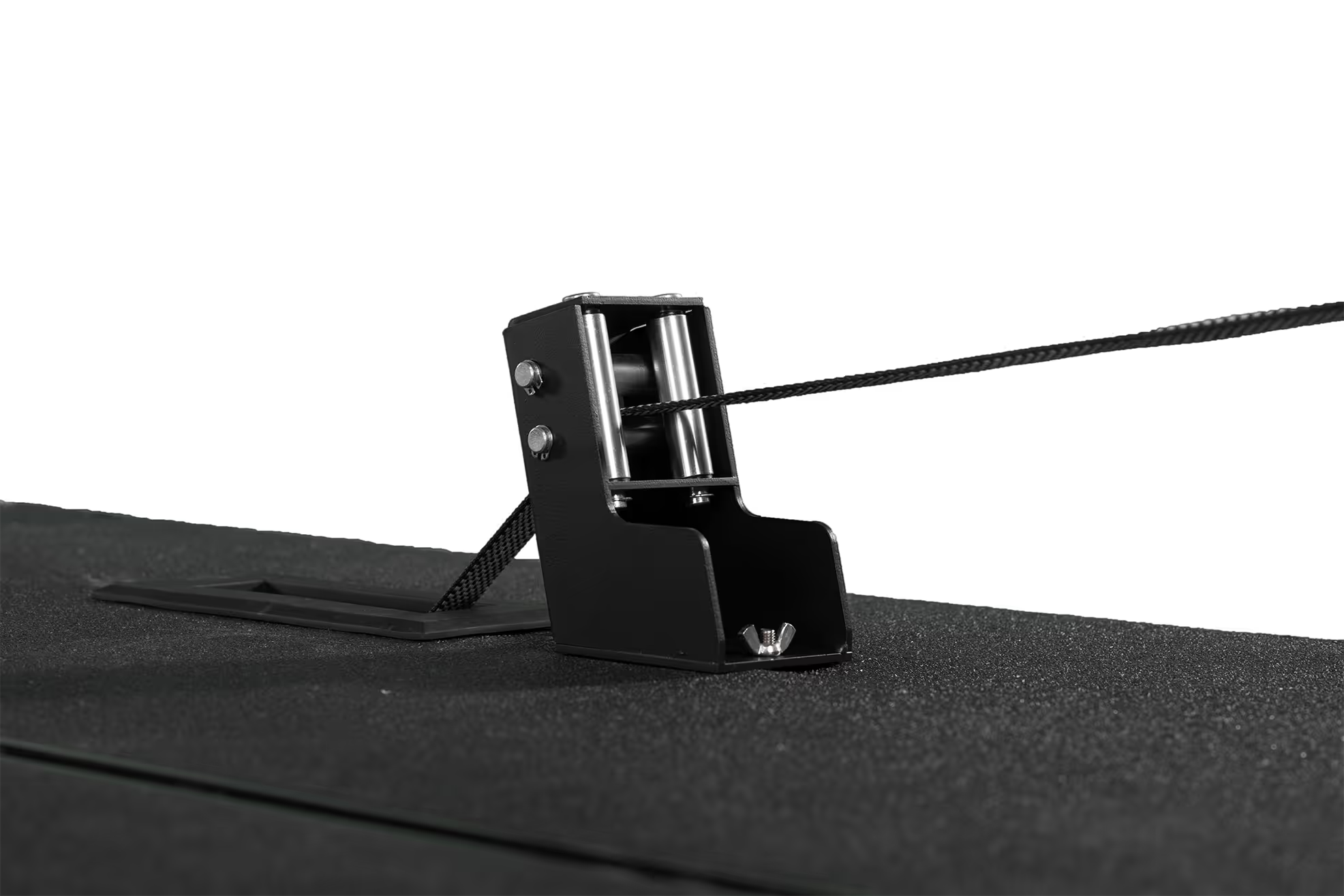




Because many traditional strength training exercises underload the eccentric phase of movements, the use of motorized resistance for eccentric overload training has become increasingly popular. However, motorized resistance can be used in a variety of ways, each involving different forms of eccentric overload.
This blog is designed to give an overview of motorized eccentric overload methods and to introduce what Exerfly Motorized Flywheel training brings to the mix.
What is motorized resistance?
First, we need to briefly discuss motorized resistance. Most traditional forms of resistance training involve lifting some sort of implement (e.g., barbell, dumbbell, etc.) against gravity. Flywheel training has emerged as a useful alternative to gravity-dependent training, with resistance coming from accelerating and decelerating spinning flywheel plates.
In contrast, motorized devices use compact motors and a software interface to provide resistance. Some devices are completely motorized, with the motor programmed to simulate the feel and demand of traditional training in different ways. Other products, like Exerfly Motorized Flywheel devices, use motorized resistance to augment an already established type of training.
Now let’s get into different types of motorized resistance and how they are used for eccentric overload training.
1. Digital motorized eccentric overload
There are two types of digital motorized resistance.
a) Added eccentric load
The most popular approach to motorized eccentric overload training involves adding extra load to lower during the eccentric phase than was lifted during the concentric phase. The motor provides a resistance designed to feel similar to lifting and lowering a weight. But the digital nature of the resistance means that the amount of load can be programmed to rapidly change as you transition between phases of the movement.
This addresses key logistical challenges involved with eccentric overload during traditional strength training exercises, such as needing weight releasers, extra spotters, or the use of specific techniques to add extra eccentric load.
But it does have a few limitations:
- The load does not adapt to your input across a set. Instead, you choose the load, and it stays locked across the set, much like traditional training.
- Adding extra load during the eccentric phase generally restricts eccentric loading to slow and heavy type loading. Undoubtedly useful but misses out on some of the benefits associated with high-speed eccentric overload training.
b) Isokinetic resistance
An alternative, but less common, approach to motorized eccentric overload is isokinetic resistance. Isokinetic resistance involves applying effort and force at a constant velocity. You set the velocity that you want to train at and put maximal force against the motor. The harder you push or pull, the more resistance it gives back to keep you at the programmed velocity.
This provides a useful form of adaptive eccentric overload, because the motor adapts to what you put into it. But isokinetic eccentric overload often involves a compromise between price, loading capacity, and versatility.
- Price: Premier isokinetic devices are often expensive and can have a large footprint.
- Loading Capacity: Low-Moderate budget isokinetic options often have an eccentric loading ceiling that could limit their use with strong athletes and/or for certain exercises.
- Versatility: Some isokinetic devices are limited in terms of the number of different exercises that can be performed on them.
Additionally, the nature of the resistance is a bit different than the dynamic actions in sport and everyday life, due to the resistance locking you into a specific movement velocity throughout the entire range of motion.
2. Motorized flywheel training
Exerfly puts a unique spin on motorized eccentric overload. The foundation of Exerfly devices is the isoinertial resistance provided by spinning flywheels. The user applies effort and force to accelerate the flywheels during the concentric phase, storing kinetic energy which is then returned as an eccentric resistance on the way back. This type of training offers a variety of unique benefits including resistance that scales to what the user puts into each rep (“user-defined resistance”) and “gravity-independent” loading that allows for high levels of effort and resistance across the entire range of motion of nearly any movement.
But by default, flywheel eccentric resistance is ~1:1 with what you put into the concentric phase. The energy you build up concentrically is what you resist against eccentrically. Specific techniques like delayed braking or assisted concentrics are needed to amplify the eccentric outputs beyond what you put in concentrically.
Exerfly addresses this limitation by combining isoinertial flywheel training with our industry-leading Motorized Flywheel Technology, allowing users to add up to 80% additional resistance in the eccentric phase. We start with a superior design and build-quality, allowing you to provide isoinertial resistance within any movement and across a wide range of loads and speeds. We then layer on the precision and loading capacity of motorized resistance, providing the best of both worlds.
So how does it work?
You select the percentage of eccentric overload that you want added to each rep and then begin your set. The device calculates how much kinetic energy you put into each rep and adds the precise amount of extra kinetic energy to resist against during the eccentric phase. Because the flywheel responds to the force and speed you put into each rep, the resistance adapts as you go. Push harder and you get more back. The motor then adds up to 80% eccentric overload, scaled to your concentric effort.

The result is a compact and robust device, built to generate very high resistances when an athlete is strong enough to produce them, and to deliver that resistance across a broad range of movement speeds. So, the same device suits everything from heavy strength work to fast, explosive training, while delivering precise eccentric overload to each rep. All while maintaining the user-defined and gravity-dependent resistance of flywheel training.
Want to learn more about the Exerfly Motorized Flywheel Technology? Check out this recent blog.
In conclusion
Motorized resistance training devices have provided options for eccentric overload training that have not previously been available. But not all motorized resistance operates the same way. It’s important to identify which factors are most important to you, such as versatility, build quality and robustness, price, footprint, and the types and amount of resistance supported by each product.
At Exerfly, we pride ourselves in not only manufacturing premium flywheel training devices, but also in providing education and support to those that are interested in how flywheel training and eccentric overload can benefit them. Be sure to get in touch or leave a comment below if you have questions or would like to schedule a call with one of our in-house sport scientists.




Lorem ipsum dolor sit amet, consectetur adipiscing elit. Suspendisse varius enim in eros elementum tristique. Duis cursus, mi quis viverra ornare, eros dolor interdum nulla, ut commodo diam libero vitae erat. Aenean faucibus nibh et justo cursus id rutrum lorem imperdiet. Nunc ut sem vitae risus tristique posuere.